PathHunter® CHO-K1 AGTRL1 Bioassay Kit
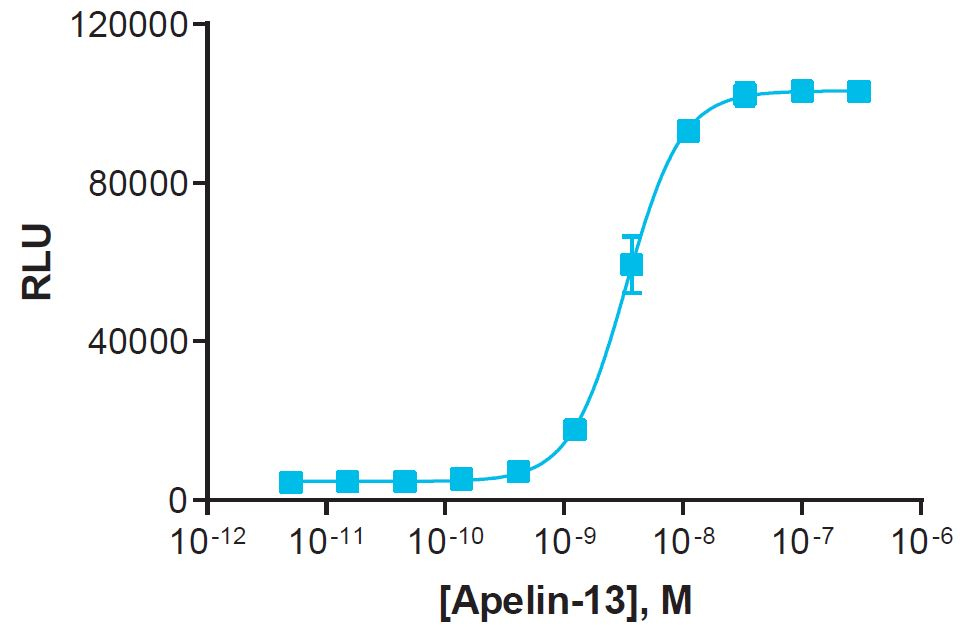
The PathHunter® CHO-K1 AGTRL1 Bioassay kit provides an easy-to-use cell based assay to measure drug potency and detect neutralizing antibodies. This bioassay assesses ligand (e.g. apelin-13) based activation of AGTRL1 GPCR via detection of β-arrestin recruitment.
Catalog #: 93-0250Y2-00121
Size:
2-Plate
Unit Price: USD 1,989.00
Log in to see your actual price
Qty
Overview
Specifications
Documentation
Resources
Related Info
Biological Background
The Apelin Receptor (AGTRL1), also known as APJ, is a class A GPCR broadly expressed in the cardiovascular system, brain, and metabolic tissues. AGTRL1 binds endogenous ligands apelin and ELABELA, regulating cardiovascular homeostasis, neuroprotection, glucose metabolism, and angiogenesis. Beyond obesity, AGTRL1 is a therapeutic target for heart failure, pulmonary hypertension, ischemic stroke, and neurodegenerative diseases.
This bioassay kit supports pharmaceutical companies developing AGTRL1/APJ-targeted therapies across multiple therapeutic areas including cardiovascular disease, metabolic disorders, and neuroprotection. Applications include agonist and antagonist characterization, potency testing, neutralizing antibody screening, and ligand bias profiling.
Eurofins DiscoverX's PathHunter® AGTRL1 kit provides ready-to-use CHO-K1 cells engineered for sensitive β-arrestin recruitment detection via EFC technology, delivering reliable results for comprehensive AGTRL1/APJ pharmacology characterization.
Product Highlights
- β-Arrestin recruitment assay: PathHunter® EFC technology for G-protein–independent AGTRL1 activation measurement, capturing biased signaling profiles
- Ready-to-use cryopreserved cells: CHO-K1 AGTRL1 cells in single-use format enabling rapid implementation from hit identification to commercial QC
- Complete kit components: Includes cells, EFC-based β-arrestin recruitment detection reagents, cell plating media, positive control agonist (apelin-13), and 96-well assay plates
- Homogeneous, no-wash format: Streamlined workflow reduces hands-on time and improves assay throughput for high-volume screening and lead optimization
- Biased signaling profiling: Ideal platform for discriminating G-protein versus β-arrestin signaling pathways to identify ligands with preferred pharmacological profiles
PathHunter AGTRL1 Bioassay Assay Principle

β-Arrestin Recruitment and PathHunter® Technology A. Upon apelin, or other AGTRL1 agonist binding, the activated AGTRL1 is phosphorylated by GPCR kinases, leading to β-arrestin-2 recruitment. This ligand-induced β-arrestin-2 recruitment activates signaling cascades independently of G-protein signaling to provide a stoichiometric, non-amplified signal. β-arrestin-2 binding blocks G-protein-mediated signaling and results in AGTRL1 internalization (endocytosis) and signal desensitization. Subsequently, the AGTRL1 is recycled back to the plasma membrane or degraded in the lysosome. This stoichiometric (1 receptor: 1 ligand), non-amplified system requires full ligand occupancy to generate maximum signal, which provides superior sensitivity for detecting AGTRL1 antagonists and improved differentiation between partial and full agonists compared to amplified second messenger systems. By analyzing the AGTRL1 β-arrestin pathway, researchers can fine-tune compound characterization when screening antagonists, distinguish between full, super, and partial agonists, and assess ligand bias by comparing β-arrestin recruitment versus G-protein signaling profiles, critical for predicting in vivo efficacy across cardiovascular, neuroprotection, and metabolic indications.
B. PathHunter® AGTRL1 bioassays utilize Enzyme Fragment Complementation (EFC) technology. AGTRL1 is fused with the small enzyme donor fragment ProLink™ (PK) and co-expressed in CHO-K1 cells stably expressing β-arrestin-2 fused to the larger enzyme acceptor fragment (EA). AGTRL1 activation by apelin, or test compounds stimulates β-arrestin-2 recruitment to the PK-tagged receptor, forcing complementation of the enzyme fragments and reconstituting active β-galactosidase enzyme. This interaction produces measurable enzyme activity detected using chemiluminescent PathHunter Detection Reagents. The β-arrestin recruitment assay offers an easy-to-use complement to cAMP and calcium G-protein–dependent pathways, enabling comprehensive AGTRL1 compound pharmacology characterization and ligand bias assessment, a universal platform that expands opportunities for developing novel AGTRL1-targeted therapeutics across cardiovascular, neuroprotection, metabolic, and obesity indications.